https://www.zerohedge.com/political/migrants-join-forces-antifa-eu-riots-spread-france-belgium
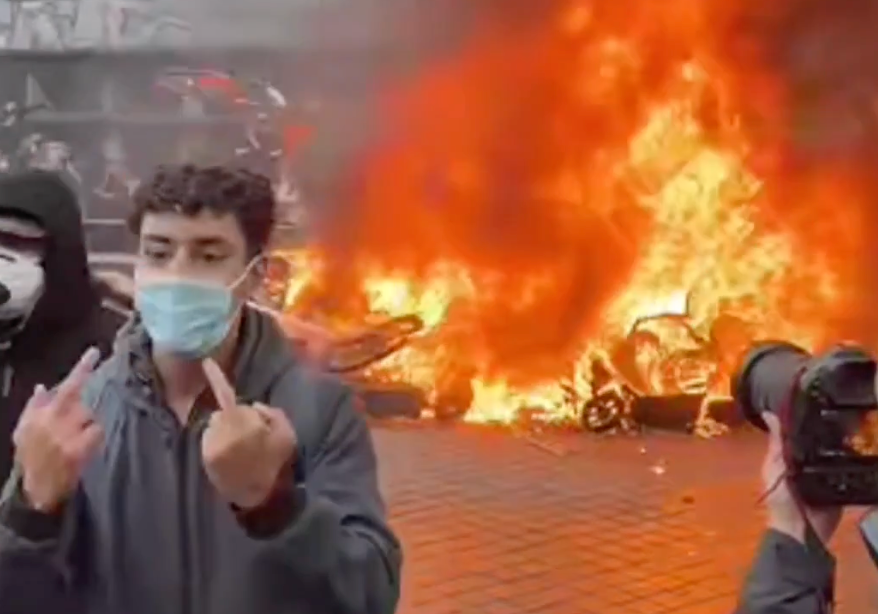
Events in Europe are demonstrating that the globalist neo - liberal experiment has failed and is going down in flames (literally), as far-left riots, which we reported last week, were "spreading like a plague in France" and had spilled out of the school yard into the streets, have now moved from France into Belgium. The civil unrest, because this has gone beyond mere student protest now, continued on Friday as hundreds of schools were forced to close. What's to say the social unrest will not resume after the weekend break

Picture: Zero Hedge
The chaos and social unrest have now spilled over from the student population as unions and political activist groups including Antifa have given their support to the protesters. The protest movement has now come to resemble widespread civil unrest last year as protests against fuel prices and the rising cost of living brought the country to a standstill
Now as then left-wing NGOs and vacillating politicians allowed the radicals to mobilize and burn down city blocks.
Social media user Visegrád 24 has pointed out that riots in Europe are taking a disastrous turn: "Young second and third-generation migrants have joined forces with Antifa for today's riots in Brussels."
The French students' protests expanded to universities on Thursday and spread across the border into Belgium. Demonstrations and property damage were reported at several schools in the eastern city of Liège, according to Euronews.
The protests began in the Paris region about a in mid - September before spreading nationwide. Students have been protesting overcrowded classrooms, teacher shortages, deteriorating school facilities, and demanding school schedules.
In Brussels and Liège, students gathered outside several schools Thursday, with police reporting that firecrackers, eggs, apples, and crowd-control barriers were thrown during the incidents. Local authorities also reported other damage, including a smashed glass door at a school, according to Anadolu Agency.
The city of Liège announced that secondary schools in its municipal network would close on Friday for security reasons, while schools in the city’s free network also announced closures, according to local broadcaster Qu4tre.
The precedent for this violence and rebellion among French youth is the near-revolution of 1968, still a nostalgic meme for Old Leftists. Students and school kids who were in revolt angered the older generations so much that they effectively delivered Right-wing governments until 1982. This echo of the French Revolution rallying cry of Liberté, égalité, fraternité, has been taken up by the far left party La France Insoumise (LFI), led by veteran radical Jean-Luc Mélenchon.
But the 21st century is a totally different political landscape in France and indeed the whole of western Europe, shaped by tensions over race and ethnic minorities, religion, identity, mass immigration, deindustrialisation in the cities and industrialised agriulture in rural areas, as much or possibly more than the neo-Marxist dreams of revolution cherished by the LFI. This is why Marine Le Pen's right wing party, Rassemblement National (RN) also has a substantial youth vote equal to or even larger than the LFI. Furthermore Le Pen's young supporters crave order and discipline over anarchy. Witnesses at RN rallies over the years speak of how Jordan Bardella, Le Pen’s young and handsome protegé and president of the RN, is greeted with pop-star style adulation when he speaks to an often hip and well-informed young audience. We are a long way from the fascist brutes of the old days of the Front National, the predecessor of today’s RN.
These are the reasons many on the moderate left in France worry that the current unrest may hand Le Pen the Presidency in next year's election.
Le Pen has now come out on national television, accusing Mélenchon of stirring up trouble in the schools. Her prescription, sidestepping the issue of immigrants, is for new, stricter laws to punish so-called “casseurs” — the most destructive of the rioters.
FROM THE ARCHIVE:
[ Farmers rebellion ] ... [ Europe unglues ] ... [ Globalism ] ... [ Net Zero reality ] ... [ Ukraine war ]
EU Technocrats Plan To Shut Down European Agricultural Industry
European farmers will gather in Brussels on Tuesday to demand guarantees from the EU Commission that changes to policy will be made to ensure the European agricultural sector remains viable. They will also demand a relaxation of the regulatory regime, and for Brussels to abandon free trade agreements with countries outside the EU, which are now being used to bring cheap into European markets
Tractors Are Heading For Central London As UK Farmers Protest
Scores of farm tractors from all over Britain were reported to be converging on Westminster as British farmers finally ran out of patience and pushed back against what they say is a lack of government support. Flying Union flags and displaying signs with slogan such as 'Save British farming' and 'No farming, no food, no future' they were gathering in London and plan to arrive in central London by early evening
Germany Running Out Of Money, Debt Levels Exploding - The Price Of War, Open Borders And Net Zero?
An urgent warning about the state of Germany's finances has been given by Finance Minister Christian Lindner. Lindner has bluntly told the government that state borrowing are growing out of hand, and the government urgently needs to reduce spending. The other coalition members, the Social Democrats, and The Greens are both spendthrift lefties so dispute over spending is only expected to escalate
Dutch Election Betrayed As Geert Wilders As EU Brokered Opposition Party Blocks Efforts To Form A Ruling Coalition
Geert Wilders, leader of the victorious Freedom Party in last November's Dutch General Election has been forced to give up his efforts to form a coalition that could command a majority in the Netherlands' state assembly and now accepts he will not be the next prime minister of the Netherlands after talks based on him leading the next government were unsuccessful.
"Like A Warzone": Farmers Surround EU Headquarters Building
Despite attempts by the EU Commission and European governments to buy time in their efforts to defuse the incendiary farmers rebellion which has spread all over western Europe, the protests are escalating again as anger in the agricultural sector flares up because the farmers feel politicians and bureaucrats are stalling the implementation of certain pledges on tax relief and easing of net zero restrictions.
Angry French farmers storm Paris agricultural show before president due to visit
Protestin French fearmer clashed with police and called for president to resign amid chaotic scenes as exhibitors and visitors at the Paris Agricultural Show anticipated the arrival of President Macon on Friday (23 February). Although the recent major protests by people involved in agriculture has died down in the past two weeks the farmers anger at the policies of Macton's globalist government and the EU commisssion is still simmering just below its flashpoint.
Farmers Blockades, Now In Second Week, Continue To Paralyze Spain
For the past13 days Spanish farmers have blocked major roads, city centres and ports, dumping imports of cheap Moroccan vegetables and cereals on the roads and marching alongside slow moving stractors tractors into the centers of large cities. Protesting farmers took over the port city of Santander last the weekend, bringing commercial activity to a stanstill. .
We Said It Was Not Over - Polish Farmers Patience Runs Out And Spanish Riot Police Take On Farm Protesters
The story dominating news and comment in the opening weeks of the year has been the farmers protests that have spread across Europe, as our food producers rebelled against the oppressive policies imposed by ruling elites more interested in virtue signalling that the welfare of their people.
Farmers Protest Movement Arrives In UK
Slow Moving Tractors Snarl Up Dover Traffic As UK Farmers Protest
As Boggart Blog and other alt_news community reported the farmers protest movement across Europe we were asked why British farmers are not protesting when they are equally hard hit by loonytoons net zero policies, high taxes and increased energy costs and constant political pressure to let good land return to a wild state lest cow farts and nitrogen emissions from fertiliser. We had to admit we did not know what was holding our lads back.
They Think Its All Over - But We Have Doubts.Victory For The Farmers As EU Drops Net Zero Targets For Agriculture After Farmers’ Protests
The European Union has backed down on Net Zero targets for agriculture, including drastic cuts in fertiliser and pesticide use and a recommendation that people eat less meat, following widespread protests from farmers. The Telegraph has moreA demand to reduce nitrogen, methane and other emissions linked to farming by almost a third has been removed from a wider Brussels plan to cut greenhouse gas emissions by 90% by 2040.
Spanish Farmers Step Up Protests In Line With France, Germany And Netherlands
Farmers in Spain have joined their counterparts in France, Germany and many other EU member states as the stepped up their protests across the country against EU green and globalist policies which are driving up costs and restricting productivity for European farmers while making importation of foods and agricultural products from non - EU countries easier.
Farmers Rebellion Blockade Germany’s Biggest Airport
While the farmers' protests in France have entered a quieter phase after the government of Emmanuel Macron caved in to some of the agricultural workers most significant demands with a caveat from the French Farmers Union that they were ready to do it all again if the government did not deliver on its promises, in Germany things seemed to be getting even more heated over the weekend.
Chaos Erupts In Brussels As Rubber Bullets Fired At Farmers Protesting Outside EU Parliament
Belgian police used Rubber bullets and water cannons against hundreds of farmers who had travelled from around western Europe to protest outside the EU Headquarters in the city on Thursday. The farmers threw eggs, set off fireworks, and set fire to staw bales and rubbish fires near the building while demanding that European leaders stop punishing them with more taxes, rising costs and the loonytoons 'green' policies imposed to push the continent towards the ruling bureaucrats impossible and irrational 'net zero' targets
Protest Becomes Open Rebellion In Europe As Farmers Uprising Against 'Green' Policies Spreads To Other Industries.
As this blog has been reporting since the late summer of 2022, farmers across many european Union member states including France, Germany, the Netherlands, Poland, Belgium, Romania, have been gradually esclating a campaign of protest against the globalist policies beimg imposed by the EU and implemented by far left governments.
Vive la Commune? The French Are Revolting again
As the well organised Farmers prepared to put into action their plan to besiege Paris and cut off supply routes delivering food to the city of approx 9 million people, the government revealed that it was in panic mode by calling in the military even at this early stage.
European Union Is Again Close To A Meltdown As Eurozone Economy Collapses
Once more we return to the political instability and economic fragility of the European Union as the conflict in Ukraine combined with loonytoons Climate Change mitigation policies, the failure of 'sustainables' to meet ever increasing demand for electricity, fod shortages and rampant price inflation put economic and social pressure on governments of member states ...
Italy Pondering Total Ban On Unvaccinated In The WorkplacesItaly's unelected governments, which has already faced riots and massive resistance to its authoritarian measures to strip away citizens rights and liberties under cover of pretending their actions are necessary steps to deal with the pandemic, now risks plunging the country into greater chaos by mandating vaccines for the workplace.
Thousands Protest In Germany Ahead Of COVID Measures Set To Go Into Effect Tuesday
Thousands of people took to the streets of Germany on Monday in protest over COVID-19 restrictions that are set to go into effect on Tuesday.The demonstrations were biggest in Mecklenburg, northern Germany, where roughly 15,000 demonstrators took to the streets to protest against tighter measures, according to local reports. In Rostock, a city along the Warnow River on the north coast of the country, roughly 6,500 people demonstrated, while in Schwerin there were roughly 2,700 and in Neubrandenburg, around 2,400 joined a demonstration.
Continue reading >>>
The Absurdity Of Vaccine Passports, Lockdowns and Segregating The UnvaxxedAfter reintroducing lockdowns from the beginning of this week in its two regions with the highest rates of COVID cases, Austria today became the first country in western Europe to reimpose a full, national lockdown which will start on Monday, November 22. The Austrial government is likely to be quickly joined by neighboring Germany, a statement from Berlin warned [...] Some commentators in Austrian capital Vienna were cynical enough to ask if the whole point of this latest escalation is justify more restrictions
Continue reading >>>
EU Dictatorship: German MEP says process of choosing Juncker successor a hoax as European elections near
The process of selecting the person who will succeed Jean-Cluade Juncker as European Commission President is a deeply flawed “hoax” dreamed up by “Eurofanatics” who want to create a United States of Europe, a German MEP said today. Hans-Olaf Henkel made his remarks as the prospective candidates – known as Spitzenkandidaten, in Germany, jockeyed for position.
With the EU elections due in May this year expected to deliver another body blow to the dream of a Federal European superstate, Europe's more conservative nationalist parties have today announced an alliance that is aiming to become the strongest group in the European Parliament, with a view to forcing to radical reform on the EU bureaucracy in Brussels, which dictates policy on security, migration, family and the environment, according to
Euro News.
Harold MacMillan’s EU warning revealed
Harold MacMillan, British Prime Minister from 1957 to 1963 gave us a chilling warning about the EEC – (European Economic Community) – before Britain joined the bloc, claiming that Germany had planned on using the trading bloc, as an instrument to assert its supremacy across the continent once more. On Wednesday, 3 April, 2019 The House of Commons voted in favour of legislation which forces the Government to request another extension for 'Brexit', giving our current Prime Minister Theresa May more time to show us the comtempt the ruling elite have for the principles of democracy.
Leaked Document Reveals Unacceptable Demands Made By EU Ahead Of Final Talks Before Brexit Deadline
A Secret document has revealed concession the EU is demanding before beginning fresh talks on Brexit ahead of the 12 april dealine. According to a memo seen by the Sunday Times, Brussels is demanding the UK must continue to pay its share of the EU budget, must implement new measures on citizens’ rights, and sign a legally binding agreement to arrangements to avoid a hard border between Northern Ireland and The Republic.
Merkel: EU Members Must Cede control Of Their Border To Brussels
German Chanellor Angela Merkel sparked outrage today and pushed the EU cloers to its final disintegration when she stated that EU Member states would be forced to surrender on of their most important sovereign powers, control of their borders, to Brussels in order that the unelected bureaucrats of the European commission could 'manage' immigration (i.e. open the border crossings and let any criminally inclined bunch of fanatics enter Europe.
We predicted last year when the socialist leader Pedto Sancjez usurped the Spanish government after the collapse of the minority government led by Mariano Rajoy collapsed, could not last. In a widely expected but destabilizing development, Spanish conservatives and pro-independence Catalonians voted to back a slate of amendments to a government budget on Wednesday by a wide margin of 191 votes out of 350,
EU Stitch Up To Promote Euronazi Selmayr’s Is Typical Of The EU's Contempt For Democracy
#
The former Prime Minister of little Luxembourg Jean-Claude Juncker to ensure his chief of staff was installed as the new Secretary-General of the European Commission, in what one senior Eurocrat has called “an impeccably prepared and audacious power-grab” at the top of the European Union.
EXPLORE:
[Daily Stirrer] ... [ Our Page on on Substack ]... [Boggart Aboad] ... [ Ian Thorpe at Quora ] ... [ Greenteeth Home ] ... [ Greenteeth on Minds.com ] ... [ Here Come The Russians ] ... [ Latest Posts ] ... [ Blog Bulletin ]