
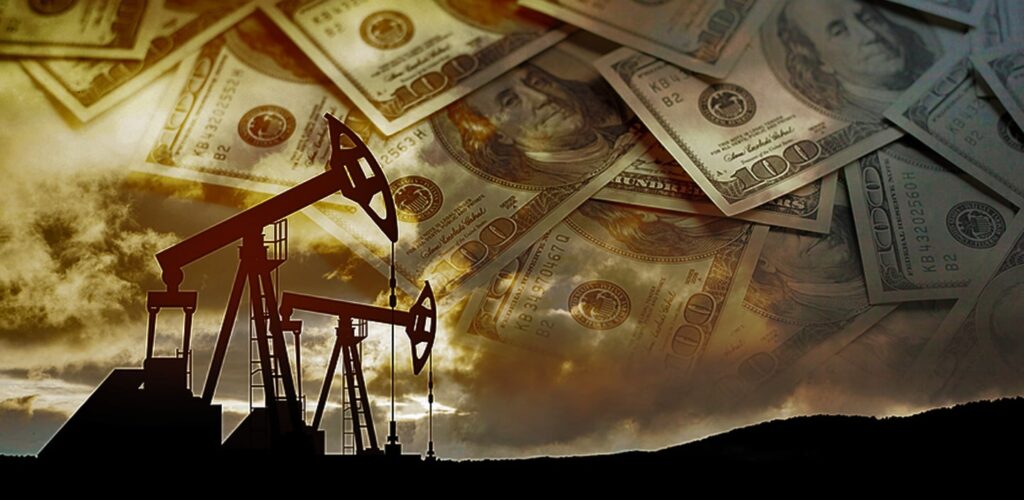
The Petrodollar system has propped up the US economy for 50 years - picture: sbcgold.com
In spite of the very fragile ceasefire in the conflict between the USA / Israel alliance and Iran, the theocratic regime of the Muslim nation has opened a new front in the war by weaponising the Strait of Hormuz against The Petrodollar.
Having made this strait a de facto toll gate at the entrance to the Persian Gulf, the Iranians are demanding that commercial vessels pay hefty transit fees in yuan or Bitcoin, according to multiple reports form news organisations in the middle east. As well as signalling a further deepening of Chinese-Iranian economic cooperation it brings a new dimension to Ian's asymmetric warfare. A huge proportion of the world's hydrocarbons supply passes through the Strait of Hormuz and significant reductions in shipping movements will trigger a global crisis.
China, Russia and Iran along with their BRICS partners have been threatening currency wars with the aim of replacing or at least offering a serious rival to the US Dollar as the primary global reserve curency.
For years, Russia and the two Asian allies have accused Washington of using the dollar's dominance in global trade as a weapon, imposing sanctions and inflicting economic pain on rivals through the dollar-dominated financial system.
Now the ongoing war aound The Gulf - and lets not fool ouselves that the current ceasefire will turn into lasting peace - is forcing a fundamental reassessment of the petrodollar system that has underpinned US financial hegemony for decades. This informal arrangement, in which Gulf oil producers price crude in dollars and reinvest revenues in US assets, emerged as a cornerstone of American economic power in the 1970s and has held since then. But with the US-Israeli campaign against Iran now in its second month, the strait’s uncertain fate is raising urgent questions about whether that order can survive.
Iran has so far managed to withstand the US-Israeli attack and inflict some damage on Israel and US allies around The Gulf, even after significant casualties aming its leadership, and has been able to assert strategic control over the Strait of Hormuz. Thus they have added a currency war to the shooting war.
This means Iran has been able to insist it will only accept payment for passage through the Strait of Hormuz in Chinese Yuan or crypto currencies, . At least two vessels have so far settled the transit fees in Yuan via a Chinese maritime services company which is acting as an intermediary and handling payment to the Iranian authorities.
This is a significant even though analysts debate if it can ultimately become decisive in the longer run. The de-dollarisation rhetoric has emanated from China, Russia, Iran and their BRICS partners for years, without materialising into meaningful change. Now, if one of the vital choke points through which one-fifth of the world's petroleum passes becomes conditional on currency denomination that is meaningful.
The practical consequence, even if it was partially adopted, would be a bifurcated global oil market. One where yuan-denominated barrels flowing through Hormuz for payment in China's currency in the Chinese payment system CIPS ( Cross-Border Interbank Payment System) and dollar-denominated barrels are rerouted at a high additional cost and time for those who are not using Chinese currency.
Further, Iran is employing a broader mechanism employing informal transactions in cryptocurrency to effectively circumvent the US financial system. Wang Yiwei, director of the Institute of International Affairs at Renmin University, said that the yuan-for-passage is more likely to gain international acceptance than a complete blockade.
Of far more concern to banks and businesses in the west if oil shipments through the strait are to be transacted in currencies other than the dollar, particularly the Chinese yuan and the Iranian rial the Gulf states, driven by security concerns, begin to distance themselves from the dollar-based energy trade, the ripple effects could be profound: reduced demand for the greenback, waning appetite for US Treasury debt, and a gradual erosion of the dollar’s reserve currency status.
FROM THE ARCHIVE:
Have you read or heard in your news supplier of choice of the recent massive troop movements in Israel, the massive build up of British, French and American warships around the approaches to the Persian gulf or just how badly the situations in Egypt and Libya have deteriorated since ...
Irony Overload: Iran Warns Obama Not To Cross Red Lines
the United States concluded an agreement with Iran which lifted US and International sanctions in return for Islamic Shi'ite Republic agreeing to limit their nuclear ability. At a high level, the US would lead the way in lifting oil and financial sanctions imposed due to Iran’s nuclear programs; in return Iran would reduce their stockpile of enriched uranium,
"West's War In Syria Is Part Of A Global war Waged By The USA And Its Dupes Allies Against Russia"
Arthur Foxake brings us a brilliant analysis of the geopolitical picture from the black Sea and Middle East, but ahead of the embed window we get a few of Arthur's own thoughts on the situation
Labour leader Corbyn rejects bombing Syria, blames BRITAIN and the US for the rise of ISIS: because it will spark more ‘mayhem’
Though the story is from The Daily Mail which, we expect to be one of the new Labour leader's greatest critics, it's good to see Mainstream Media actually reporting one of the things Jezza is getting right. Obviously he reads The Daily Stirrer because we've been saying since ISIS were pulled out of ...
How Hillary Clinton Planned The Syrian Holocaust We bring you evidence that the destruction of Syria was planned by the USA and Israel long before the US engineered 'spontaneous uprising'known as The Arab Spring ...
Another Obama Sponsored Genocide - not Alawi or Christians In Syria but Yazidi in Iraq.While the west has been distracted by events in Gaza and Ukraine, and the neo - fascist 'left' have suddenly discovered the joys of anti Russianism and anti Semitism, the FUKUS axis sponsored genocidists of ISIS have discovered another inoffensive minority to exterminate now that the Syriac Christians have fled.
More Than ISIS, Iraq’s Sunni Insurgency
The story emerging in Iraq is of another American foreign policy fuck up, a total misreading of the situation by the world's most parochial global power. By December 2013, Sunni leaders had become tired of the jihadi group the Islamic State of Iraq and al-Sham (ISIS) actions in their areas and publicly supported the Iraq government’s military campaign against the group’s bases. Unfortunately the ISIS rebels were armed with US military technology and Obama was calling for the resignation of the government in Baghdad, prompting Russia and Iran to support them ...
Poison Gas Used In Syria Sparks Calls For Western Military Invasion
Claims circulating in Washington, London and Brussels that chemical weapons have been used in the Syrian conflict have prompted less conspiracy theories and more intelligent discussion that we might expect. Even so commentators in mainstream media have divided into two opposing camps – those who believe that President Obama's failure to ...
An Islamic cleric has pronounced a fatwa that permits US-backed FSA rebels to rape non-Sunni women in Syria as part of a "sexual jihad" that has so far involved girls as young as 14 being transported to remote areas of the country to service the needs of ...
France sends more troops to Mali as UN backs intervention
A contingent of 750 French troops has joined the offensive against Islamist rebels in Mali, French president Francois Hollande said in Abu Dhabi on Tuesday after France secured fresh UN backing for its military action
Over 4000 Civilians Have Died In Forgotten War.
As attention has focused on Syria ans then on the efforts of the Obama administration, in its dying months, to avenge the defeat of the anointed successor Hillary Clinton and discredit the election victor and President - elect Donald Trump, and simultaneously demonize Russia and President Putin
I Would Do anything To Get Assad Out Of Syria Says Cameron
Syrian president Bashar Assad could be allowed a free pass to flee his country if it would end the bloodshed, David Cameron said today. The Prime Minister said he would do ‘anything to get that man [Assad] out of the country’ but refused to offer Assad a safe haven in Britain. Mr Cameron is on the second day of ...
Will Egypt Seize Libya For Its Oil
If the conflict in Syria, currently showing signs of spreading to Turkey, Iraq and Kurdistan were to escalate into a regional war, a proxy for east and west to butt heads without sustaining too much domestic damage, is Egypt likely to take advantage of the distraction and
EXPLORE:
[Daily Stirrer] ... [ Our Page on on Substack ]... [Boggart Aboad] ... [ Ian Thorpe at Quora ] ... [ Greenteeth Home ] ... [ Greenteeth on Minds.com ] ... [ Here Come The Russians ] ... [ Latest Posts ] ... [ Blog Bulletin ]

