The secret of freedom lies in educating people, whereas the secret of tyranny is in keeping them ignorant. - Maximilien Robespierre.

Monday, March 21, 2022

News Roundup - 21 March 2022

Severe Drought & "Dust Bowl Conditions" Threaten Disastrous Winter Wheat Harvest In The US

Authored by Michael Snyder via TheMostImportantNews.com,

Food prices in the U.S. have already been soaring, and now we are on track for an absolutely horrible winter wheat harvest.  Of course this comes at a time when the war on the other side of the globe is going to greatly reduce wheat exports from Russia and Ukraine.  Over the last 12 months, the price of wheat has already risen 69 percent, and now this crisis threatens to go to an entirely new level.  In all my years of writing, I have never seen anything like this, and I am deeply concerned about what the months ahead will bring.

Due to extreme drought, winter wheat is in very bad shape in states such as Kansas, Oklahoma and Texas.  The following comes from one of the most prominent agricultural websites in the entire country…

Some farmers in southwestern Kansas, the top U.S. wheat producing state, have not received much measurable rain or snow since October. Winter wheat is planted in autumn, lays dormant in winter and begins sending up green shoots in spring. Proper soil moisture is critical at this stage for the crop to thrive.

More than half of Kansas was classified as under severe drought or worse as of March 8, the driest conditions since 2018, according to the National Drought Mitigation Center. Severe drought is also covering three-quarters of Oklahoma and more than two-thirds of Texas, both of which also are large wheat producers.

If that sounds really bad, that is because it is really bad.

Farmers are praying for rain, because they desperately need it.


Evidence-based medicine has been corrupted by corporate interests, failed regulation and commercialisation of academia, which act to suppress negative trial results, conceal adverse events and withhold raw data from the academic research community, according to a peer-reviewed article in the British Medical Journal by Jon Jureidini of the University of Adelaide and Leemon B. McHenry of California State University.

Medicine is largely dominated by a small number of very large pharmaceutical companies that compete for market share, but are effectively united in their efforts to expanding that market. The short term stimulus to biomedical research because of privatisation has been celebrated by free market champions, but the unintended, long term consequences for medicine have been severe. Scientific progress is thwarted by the ownership of data and knowledge because industry suppresses negative trial results, fails to report adverse events, and does not share raw data with the academic research community. Patients die because of the adverse impact of commercial interests on the research agenda, universities, and regulators.

The pharmaceutical industry’s responsibility to its shareholders means that priority must be given to their hierarchical power structures, product loyalty, and public relations propaganda over scientific integrity. Although universities have always been elite institutions prone to influence through endowments, they have long laid claim to being guardians of truth and the moral conscience of society. But in the face of inadequate government funding, they have adopted a neo-liberal market approach, actively seeking pharmaceutical funding on commercial terms. As a result, university departments become instruments of industry: through company control of the research agenda and ghostwriting of medical journal articles and continuing medical education, academics become agents for the promotion of commercial products. When scandals involving industry-academe partnership are exposed in the mainstream media, trust in academic institutions is weakened and the vision of an open society is betrayed.

The corporate university also compromises the concept of academic leadership. Deans who reached their leadership positions by virtue of distinguished contributions to their disciplines have in places been replaced with fundraisers and academic managers, who are forced to demonstrate their profitability or show how they can attract corporate sponsors. In medicine, those who succeed in academia are likely to be key opinion leaders (KOLs in marketing parlance), whose careers can be advanced through the opportunities provided by industry. Potential KOLs are selected based on a complex array of profiling activities carried out by companies, for example, physicians are selected based on their influence on prescribing habits of other physicians. KOLs are sought out by industry for this influence and for the prestige that their university affiliation brings to the branding of the company’s products. As well paid members of pharmaceutical advisory boards and speakers’ bureaus, KOLs present results of industry trials at medical conferences and in continuing medical education. Instead of acting as independent, disinterested scientists and critically evaluating a drug’s performance, they become what marketing executives refer to as “product champions.”

I suspect the authors’ confidence in Government and public funding to free medicine from predetermined agendas is misplaced, as the Government propaganda during the pandemic (and on numerous other issues) has shown. But the points about the corruptions that the dominance of big pharmaceutical companies bring to the development and testing of medicine deserve to be taken seriously.

Worth reading in full.

By Will Jones  /  21 March 2022 • 13.35

India Ignores Western Pressure, Buys 'Cheap' Russian Crude

from Zero Hedge, 21 March 2022

With China refusing to bend the knee to Washington's "denounce Putin" demands, it appears the Biden administration's narrative that the world is united against Russia is creaking at the seams as Bloomberg reports that cheap Russian Urals crude is finding willing buyers in India.

And why wouldn't they... With Urals Crude trading at a stunning $30 discount to Brent, who can blame India for snapping it up.

"Russia is offering oil and other commodities at a heavy discount. We will be happy to take that," one of the Indian government officials said.

The official added that such trade required preparatory work including transportation, insurance cover and getting the right blend of crude, but once that was done India would take Russia up on its offer.

Hindustan Petroleum Corp. recently bought 2 million barrels of the grade for delivery in June, and other processors are also seeking cargoes, according to people familiar with the matter. Mangalore Refinery and Petrochemicals Ltd. and Bharat Petroleum Corp. are looking to buy Urals crude for delivery in May and June, the people familiar with the plans said.

Oil Minister Hardeep Singh Puri told lawmakers on Monday that Indian buyers have contracted the equivalent of about three days’ worth of the nation’s oil needs from Russia, which will be supplied over the next three to four months. That works out at about 15 million barrels of Russian oil, given India’s daily oil requirement of five million barrels.

“Even if we were to scale this up considerably, it would still be literally a drop in a larger bucket,” the minister said in India’s parliament.

Bloomberg does note that, as many western and Asian banks have stopped issuing letters of credit for Russian shipments, it remains to be seen just how much Urals - which mostly loads at Baltic Sea ports - will flow to Asia.


Continue reading >>>
[Daily Stirrer] ... [ Our Page on on Substack ]... [Boggart Aboad] ... [ Greenteeth Home ] ... [ Greenteeth on Minds.com ] ... [ Here Come The Russians ] ... [ Latest Posts ]


BBC Edits Article to Admit Alleged Female Serial Killer Is a Biological Male

 

Harvey Marcelin police mugshot

The BBC has been forced to amend an article on alleged transgender serial killer Harvey Marcelin to reflect the fact that the convicted murderer is a biological male.

Marcelin, who was previously imprisoned for over 50 years for killing two former girlfriends, was charged earlier this month with second-degree murder after a woman’s dismembered torso was discovered in Brooklyn.

In an article published on March 14th, the British publicly-funded broadcaster initially failed to mention the alleged killer was transgender and born as a biological male, referring to Marcelin as “her” and “she” throughout.

The article was updated on the 15th, with an addition at the bottom of the story that read: “She now identifies as a transgender woman.” It was further amended on the 17th to note that Marcelin “recently identified as a woman”.

Confirming the changes, a spokesman from the BBC told GB News: “This article used the suspect’s male name. It was amended to make clear that Harvey Marcelin had recently identified as a woman.”

The BBC was not alone in failing to mention the killer’s biological sex and transgender status. An article from the New York Times, for example, merely referred to Marcelin as “An 83-year-old Brooklyn woman”.

Despite the alleged gender transition — there is no evidence that Marcelin has undergone surgery — court records from a State Parole Board hearing in 1997 found that the killer admitted to having “problems” with women.

Continue reading >>>
[Daily Stirrer] ... [ Our Page on on Substack ]... [Boggart Aboad] ... [ Greenteeth Home ] ... [ Greenteeth on Minds.com ] ... [ Here Come The Russians ] ... [ Latest Posts ]

Sunday, March 20, 2022

Oh what a lovely war! Taking Sides In The Ukraine Conflict

 by Roger Watson, The Salisbury Review, March 2022

Dr Strangelove or 'How I learned to love the Bomb'


I am a First Gulf War veteran and one of my sons, when very young, asked me which ‘team’ I had been on as if that was a choice for a British soldier. I was recently asked by one of my not so young grandsons which ‘team’ I supported in the war between Ukraine and Russia. Years of online gaming combined with a crumbling state educational system have led young boys to consider that war really is just a game. My son subsequently joined the British Army as a boy soldier through the wonderful Army Foundation College and served for six years so I think his delusions were soon crushed. My grandson received a lecture from me on the nature of war.

But, as I look around me in Britain while part of Europe descends into chaos, I cannot help getting the impression that people here do see this war as a kind of game, and when I catch a painful glimpse of the war reporting on our mainstream media, I see why. It is terrible, over-dramatic and one-sided. Houses in my city are displaying the Ukrainian flag as if we were approaching the final of the world cup and we all ‘supported’ Ukraine. The media are clearly pushing a pro-Ukraine view of the war which is whipping the British public into an anti-Russian frenzy. Thus, we cancel music by Tchaikovsky and a school decides to stop teaching Russian children at weekends. However, every cloud has a silver lining for Russian people living in Russia as Ikea closed its stores and ITN pulled I’m a Celebrity from Russian TV. But joking aside, we seem to have taken leave of our senses here with the view that Russia and therefore Russians represent all things bad and, concomitantly, Ukraine and therefore Ukrainians represent all things good.

As exhorted in an excellent article by Alice Salles in Mises Wire recently, I refuse to take sides in this conflict. To the serried ranks of the virtue-signalling Twitterati this seems to make me a swivel-eyed Putin-loving Russophile. This is far from the case. I have long considered Putin to be a bad ‘un. Something he has proved in an act of military madness and nuclear sabre rattling towards NATO. Nevertheless, he made his intentions clear for years in speeches and abundantly clear by massing troops at the Ukrainian border in recent months. Seemingly we paid little attention until it was probably too late. He must be taken seriously because he is dangerous. I find it harder to take seriously his opposite number in Ukraine, former comedian/actor turned President Zelensky who seems to add another signature to his death warrant daily by appearing on television and taunting the Russians. Moreover, he is being goaded on by us through the provision of the wherewithal to kill the advancing Russian troops. ... Continue reading >>>


Is the death toll of the vaccines becoming impossible to ignore?

 from D V Williamson, The Free Range Economist, Substack, 20 March 2022

What is going on?

Summary of Results —

  • Data from the Centers for Disease Control (CDC) show that, starting in early May, 2021, people have been dying at exponentially increasing rates from conditions involving “Symptoms, signs and abnormal clinical and laboratory findings, not elsewhere classified”.  The seasonal, baseline rate in a given January for such “abnormal” conditions would be nearly 700 fatalities per week, but by January 1, 2022 the actual rate had exceeded 3,000 per week and was still sharply increasing.

    An obvious hypothesis is that the COVID vaccines (the mRNA therapies) have induced these fatalities.  Specifically, in 2021, deaths in excess of baseline rates that the CDC attributes to “Symptoms, signs and abnormal clinical and laboratory findings, not elsewhere classified” very nearly totaled 22,000.  The data indicate at least another 21,000 fatalities in excess of baseline fatalities through the first eight weeks of 2022.  That would put the death toll from the jab in excess of 43,000 as of February 26, 2022.

  • CDC data indicate that fatalities from unnatural causes in excess of baseline rates totaled nearly 20,000 in 2020 and exceeded 20,000 in 2021.  These fatalities started to depart from the baseline in April 2020.  It was at just that time that non-COVID fatalities among people under the age of 45 started to pick up.  Absent evidence to the contrary, it is hard not to conclude that young people and people of prime working age were committing suicide or succumbing to drug overdoses or alcohol poisoning at rates on the order of 500 a week in excess of baseline rates. ... Continue reading >>>


French Police Use Teargas As Freedom Convoy Brings Thousands Of Protestors To Paris
Inspired by Canada's freedom Convoy, a sponaneous protest by drivers of heavy trucks against the fasistic and oppressive curtailment of individual freedoms by Prime Minister Trudeau's regime, French truck drivers protesting President Macron's similarly authoritarian measures converged on Paris where they were met by riot police enforcing Macron's ban on protests against government policy ...

[Daily Stirrer] ... [ Our Page on on Substack ]... [Boggart Aboad] ... [ Greenteeth Home ] ... [ Greenteeth on Minds.com ] ... [ Latest Posts ]
Saturday, March 19, 2022

News Roundup - 19 March 2022

Covid Deaths “Impossible to Calculate” as Authorities Used 14 Different Definitions, Say Oxford Researchers

 By Will Jones  /  19 March 2022 • 12.02 via Daily Sceptic, 19 March 2022

The number of people who have died from Covid in the U.K. during the pandemic is impossible to determine because of the inconsistent definitions of what is meant by a coronavirus death, researchers at Oxford University have concluded. The Telegraph has the story.

Experts from Oxford University discovered that public health and statistics organisations across the U.K. are operating under 14 different definitions to classify a death from Covid.

Freedom of Information (FOI) requests, collated for a new report published on Saturday, show that many people who died in the first wave never tested positive for the virus, particularly older people who died in care homes.

Instead, their deaths were registered as Covid simply based on a statement of the care home provider, and because coronavirus was rife at the time.

In some care homes, more than half of the Covid deaths were registered in people without pre-existing conditions, which the report authors said was “implausible” for people who needed residential care.

The authors also point out that it is unlikely that a Covid infection on its own could cause death in the absence of contributing factors, such as other illness, or the infection leading to a more deadly condition such as pneumonia.

The report also found that in some trusts, up to 95% of Covid deaths were in people with Do Not Resuscitate (DNR) orders.

The team said the confusion meant they were unable to separate deaths caused by Covid from those triggered by the pandemic response, and called for a proportion of deaths to be verified by post-mortem in future pandemics to determine the true reason.

Worth reading in full and find the report here.

 Continue reading >>>
[Daily Stirrer] ... [ Our Page on on Substack ]... [Boggart Aboad] ... [ Greenteeth Home ] ... [ Greenteeth on Minds.com ] ... [ Latest Posts ]

How Volatile Is Offshore Wind?

by Paul Homewood, Notmanypeopleknowthat, 18 March 2022 


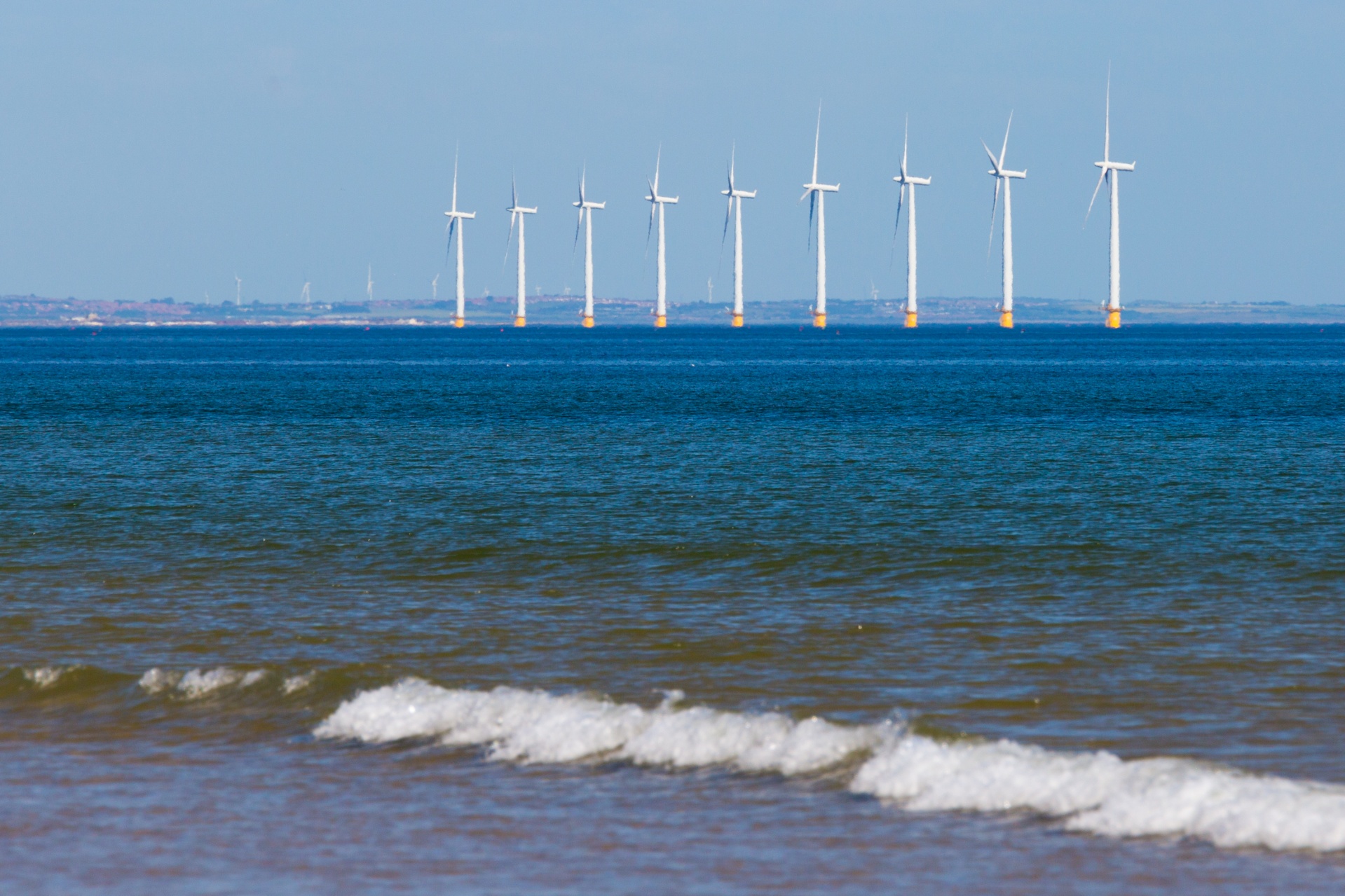
Offshore Wind Turbines

It is commonly claimed that the wind is much more constant and reliable in the North Sea and around Britain’s coasts than it is inland. “The wind always blows!”

But how true is this?

The Low Carbon Contracts Company, who manage the CfD system, provide daily data for generation by all generators with contracts. In particular there are sixteen offshore wind projects on their database, which offer a good geographical spread. They account for about a half of total UK offshore generation:

image

I have analysed January 2022 data for these, and below is the daily output:

image

https://www.lowcarboncontracts.uk/data-portal/dataset/actual-cfd-generation-and-avoided-ghg-emissions

Far from being “constant”, we can see that wind power is extremely volatile. Daily production ranges from 8322 to 84984 MWh, with a monthly average of 49245 MWh.

There were thirteen days when output was below 45000 MWh, in other words more than 10% below average.

There were seven days in the month when it failed to reach 25000 MWh. The average for those days was 17000 MWh, equivalent to them working at 15% of capacity. The worst day, when output was 8322 MWh, offshore wind was only operating at only 7% of capacity.

Bear in mind as well that this is winter, not summer when you might expect low wind speeds.

We have been promised 40 GW of offshore wind by 2030, but in reality the most we can actually rely on is 3 GW.

Continue reading >>>
 

[Daily Stirrer] ... [ Our Page on on Substack ]... [Boggart Aboad] ... [ Greenteeth Home ] ... [ Greenteeth on Minds.com ] ... [ Latest Posts ]


By Camilla Tominey, Associate Editor 18 March 2022 • 7:18pm Tony Sewell's race report was met with an 'avalanche of criticism' when it was published last year Credit: Clara Molden 
 
 When Dr Tony Sewell, the charity worker and author of a Government report on race, had the offer of an honorary degree withdrawn by Nottingham University last year, it reminded him of being racially abused as a young black boy growing up in Brixton.

“Those people just thought of me as one thing, and they hated it. It almost feels like that with the university. They’re like those guys who shouted out the N-word at me when I was seven.” It did not matter that Nottingham had previously honoured former Chinese ambassadors who have cast doubt on the Uighur genocide, and a Malaysian politician found guilty of embezzlement. Or that a senior official at the university has earned almost £150,000 from a Kremlin-linked firm suspected of supplying steel to build Russian tanks. 
 
Sewell’s honorary degree was cancelled in December because he had produced a landmark report that concluded that the “claim the country is still institutionally racist is not borne out by the evidence”. 
 
 The 258-page report by the Commission on Race and Ethnic Disparities (CRED), led by Sewell, was met with what the Guardian newspaper described as “an avalanche of criticism” when it was published in March last year, in the wake of George Floyd’s death and the subsequent Black Lives Matter protests. 
 
Its conclusion that racism is a “real force” in Britain, but that it is no longer a country where the “system is deliberately rigged against ethnic minorities”, was met with derision by anti-racism campaigners who were also unhappy about the report’s criticism of the “accusatory tone of much of the current rhetoric on race, and the pessimism about what has been, and what more can be, achieved” ... Continue reading >>>

EXPLORE: [Daily Stirrer] ... [ Our Page on on Substack ]... [Boggart Aboad] ... [ Greenteeth Home ] ... [ Greenteeth on Minds.com ] ... [ Latest Posts ]

These Charts Show Russia's Invasion Choking World Of Natural Resources

from Zero Hedge, 19 March 2022

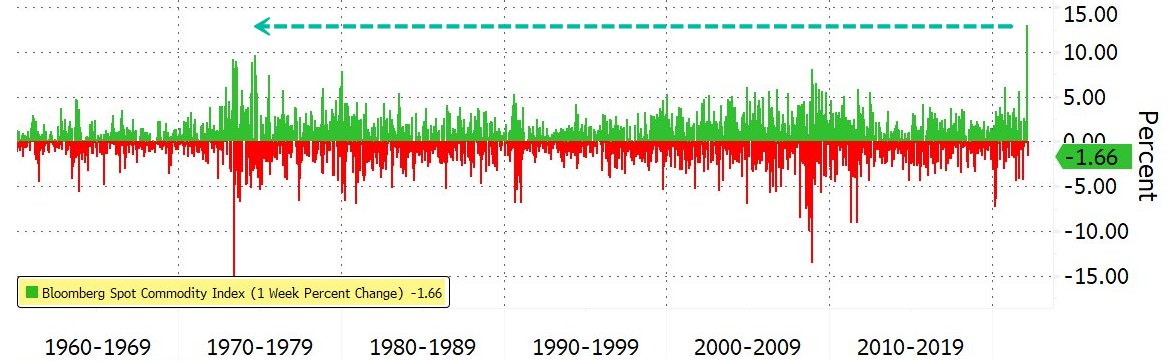
For weeks, we've detailed how Russia's invasion of Ukraine has sparked one of the most significant commodity shocks the world has ever experienced. It even supersedes changes to commodity markets in the 1970s and involves every commodity from grain to fertilizer to crude to metals. 

In a series of charts (provided by Bloomberg), we will show just how the Ukrainian conflict and Western sanctions on Russia are choking the world's supply of natural resources, driving up prices. 

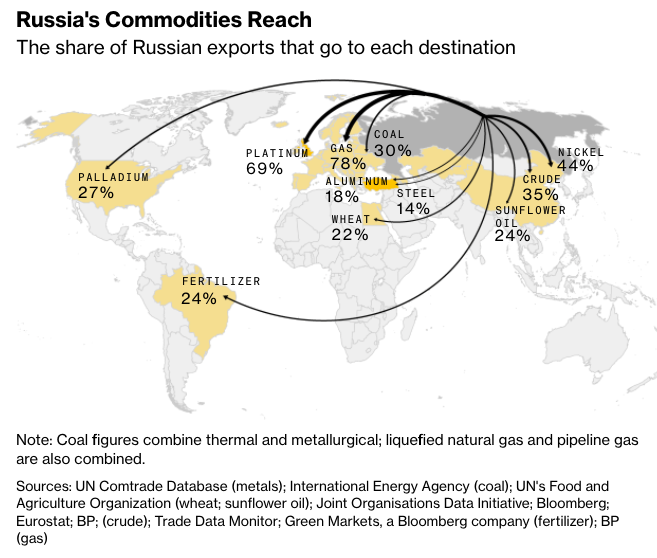
Russia is a top exporter of many commodities.

Here is the share of Russian exports for each region of the world. The U.S. and allies implementing bans on Russian crude and other commodity exports have disrupted global trade and unleashed supply constraint fears (here's why banning Russian crude imports is risky). 

Anyone who has filled up their fossil fuel vehicle has noticed prices at the pump have soared since the invasion. That's because Russia is the second-largest crude exporter globally, behind Saudi Arabia. The U.S., U.K., and Canada have banned imports of Russian imports, sending energy markets into turmoil.

Continue reading >>>
[Daily Stirrer] ... [ Our Page on on Substack ]... [Boggart Aboad] ... [ Greenteeth Home ] ... [ Greenteeth on Minds.com ] ... [ Latest Posts ]

“Fully vaccinated” Millennials are reportedly dropping like flies due to Wuhan coronavirus (Covid-19) “vaccines,” and former Wall Street guru Edward Dowd wants to start a national conversation about it to penetrate the establishment media’s “blackout” of the situation.

“That’s my goal, to just change the conversation, to give people cover,” says Dowd, who used to manage portfolios for the multinational investment firm BlackRock.

“Once the subject is broached, you don’t sound as crazy, if some other guy said it before you,” he told the independent media outlet WND.

With the help of a Wall Street insurance analyst, Dowd discovered that based on data from the U.S. Centers for Disease Control and Prevention (CDC), the Millennial generation has suffered a “Vietnam War event” with more than 61,000 excess deaths between March 2021 and February 2022.

In the fall of 2021, there was a particularly significant “spike” in deaths among jabbed young people that cannot be explained by the so-called “delta” variant, opioid abuse, suicide or other causes.

“The only signal that makes sense to me is the vaccines,” says Dowd, who describes himself as a “futurist” and a “stock picker.”

Back in February, Dowd sounded the alarm about Big Pharma’s liability shield concerning covid jab injuries and deaths.

Because of what Congress wrote into the law, which Donald Trump signed off on, just prior to the release of the shots, the pharmaceutical industry cannot be legally held accountable for the carnage caused by these deadly injections ... Continue reading >>>


Friday, March 18, 2022

The Dominance Of The U.S. Dollar Is Fading Right Before Our Eyes


Submitted by QTR's Fringe Finance via Zero Hedge  
18 March 2022

It was just a couple of weeks ago that I wrote an article arguing that the economic sanctions we have cast upon in Russia, due to its invasion of Ukraine, likely mark the beginning of a period where China and Russia would bifurcate the global monetary system, leading them to eventually challenge the U.S. dollar’s reserve status. 

Now, Saudi Arabia is joining the fray, further threatening to tip the balance of the global monetary scales that have kept the U.S. dollar afloat for decades.

The fact that predictions of a “new economy” and “new monetary system” only exist on fringe blogs like mine and haven’t gone mainstream given the current economic situation with Russia (even amidst our abuses of printing the dollar over the last several decades) is baffling to me.

As I noted to Andy Schectman in a recent podcast, our quality of life in the United States and our nation’s entire economy is an elephant balancing, on one leg, on the toothpick of the U.S. dollar’s reserve status.

Our quality of life relies solely in our unique ability to import the goods and services that we use and need on a daily basis, while exporting US dollars. We’ve been able to print trillions of U.S. dollars into existence over the last couple of years - monetary policy that is anything but sound, regardless of whether or not your currency has global reserve status – because of the luxuries afforded to us by the dollar’s global reserve status.

But this reserve status, and the $30 trillion in debt we have accrued and convinced ourselves we will never have to pay, quickly go from being long-term liabilities that we can theoretically ignore to current liabilities that we must address if the dollar is ever legitimately challenged.


Today’s blog post is free because I believe the content to be far too important to place behind a paywall. If you have the means and would like to support my work, I’d love to have you as a paid subscriber: Subscribe now


Challenging the dollar’s reserve status would be an obvious and immediate catalyst that would flip everything we think we know about economics in our country on its head. Our monetary policy blind spots, that we have been willfully ignoring for decades, would instantly become leverage for the rest of the world.

The stage appears to remain set for this to happen. Globally, if you are an enemy of the United States, the situation hasn’t looked better to challenge the U.S. dollar, maybe ever, than it does now:

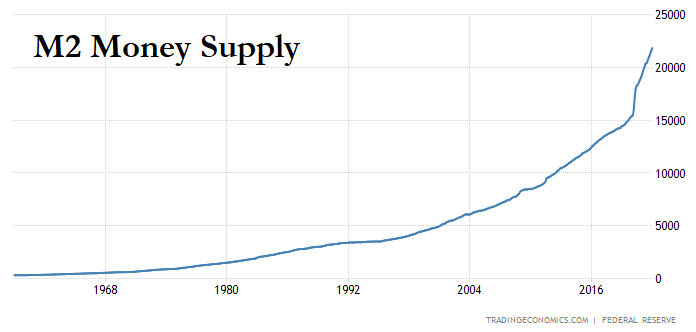
  • We have run up a mountain of debt and grossly expanded our money supply in an extremely short period of time

  • We are the most reliant we have ever been on other countries to import goods and services

  • We have a presidential administration that (1) doesn’t understand basic economics and (2) is limiting our nation’s ability to produce commodities, which act as a foundation for a country’s inherent wealth

  • We are about to enter into a economic recession

  • Inflation is setting records and is already bankrupting the middle and lower class of our nation, before even considering a potential challenge to the dollar

And while a week or two ago I was only worried about China and Russia, now that the world has been forced to pick economic sides, other nations are throwing their respective hats in the ring, too.

Saudi Arabia, which is a nation of major consequence economically due to its significant oil and gas reserves, has reportedly embraced the idea of accepting Yuan instead of dollars for Chinese oil sales.

Not unlike Russia and China’s plans to de-dollarize, that date back nearly a decade, the Saudis have been considering this idea for six years already. And not unlike Russia and China’s new economic tie-up, the catalyst for speeding up the process has been U.S. foreign policy:

Saudi Arabia is in active talks with Beijing to price some of its oil sales to China in yuan, people familiar with the matter said, a move that would dent the U.S. dollar’s dominance of the global petroleum market and mark another shift by the world’s top crude exporter toward Asia.

The talks with China over yuan-priced oil contracts have been off and on for six years but have accelerated this year as the Saudis have grown increasingly unhappy with decades-old U.S. security commitments to defend the kingdom, the people said.

The consideration by Saudi Arabia is consequential.

It shows that other nations, when forced to choose sides between the U.S. and its foes, don’t feel obligated to commit to the U.S. dollar, further undermining the world’s perception about the dollar’s strength.

Not unlike Russia, Saudi Arabia is a country that, regardless of how much its currency may “devalue” versus a fiat basket of currencies, is still backed by finite resources.

This gives the country and its currency intrinsic strength. Russia seems to understand this. In fact, just this morning, Russian Foreign Minister Sergei Lavrov, likely alluding to this fact, said that economic sanctions against Russia make the country “stronger”.

Saudi Arabia is now another serious name on the list of contenders who have the currency bite to back up the economic rhetoric bark of challenging the dollar.

As The Wall Street Journal notes, the Saudis have “traded oil exclusively in dollars since 1974, in a deal with the Nixon administration that included security guarantees for the kingdom.”

The U.S. dollar’s ties to oil have been crucial in helping prop up the currency’s demand globally. These ties have also helped drum up the psychological buy-in necessary for the world to collectively accept that “the next guy” is going to want their U.S. dollars.

But given the alliance between Russia and China – and the newfound alliance between Saudi Arabia and China - it looks as though that confidence game might be coming to an end right before our very eyes.

In other words, the dollar could be fading from the global picture like Marty McFly’s brother from that family photo in Back to the Future.

We may not notice it right away…

…but eventually it’ll be clear.

Far be it for me too be a harbinger of too many uncomfortable predictions at once, but, as I wrote last year, I also strongly believe that China will eventually back its forthcoming digital currency with gold to further strengthen its economic and monetary posture globally.

The contrast between a forthcoming divided global economy would be stark: nations like China and Russia seem genuinely interested in the idea of sound money backed by commodities, while the United States seems preoccupied with jargon filled academic circle jerks trying to convince ourselves that debt is money that “we owe to ourselves”, to quote Paul Krugman, and that money literally grows on trees.

If given the choice between the two ideologies, where do you think the world is going to wind up?

I’m not sure we’re ready to embrace the answer here in the United States, but we better get ready to.

--

Thank you for reading Fringe Finance. This post is public, so feel free to share it.

*******************************************************************************************************

RELATED:
[ Currency wars ] ... [Russia catalog ] ... [ Green dreams ] ... [ Russia, Ukraine food supply chain ] ... [ Food chemicals ] ... [ The Russians Are coming ]

EXPLORE: [Daily Stirrer] ... [ Our Page on on Substack ]... [Boggart Aboad] ... [ Greenteeth Home ] ... [ Greenteeth on Minds.com ] ... [ Latest Posts ]


Boris and Biden Can't Blame Ukraine War For Energy Crisis


Protestors in Berlin have been holding up placards suggesting they’d sooner shower in cold water than use Russian gas, others however are more concerned about how they will keep warm and cook their food while still others are wondering how they will for to fill their cars with fuel for the commute to work, or buy food with the prices of both fuel and food rocketing.

Meanwhile in Britain Boris Johnson has called on the public to make sacrifices, solemnly telling us that we need to drop cheap Russian energy and ‘accept that such a move will be painful’.

Telling voters that the spiralling inflation we are now experiencing, and the effect on living standards might sound like a politiian trying to be honest for once . Or might it be the case that Boris Johnson, never a man known for plain speaking, is preparing us to be told that Russia’s war against Ukraine, rather than the follies of 'net zero' policies and transitioning from fossil fuels to intermittent 'sustainable' energy sources are to blame for price rises that coming down the lione long before the first Russian boot stepped over ~Ukraine's border?

Managing without Russia’s energy supplies will hit the Germany economy hard. German industry and domestic energy supplies have relied heavily on imported Russian natural gas since Germany's influential but idiotic Green lobby pressured Angela Merkel into abandoning coal and nuclear in favour of wind and solar electricity generators. Germany imported 32 per cent of its gas from Russia in December and wants to reduce that by two-thirds over the next year but has no viable alternative and even Germany's brilliant engineers cannot conjure current from wind turbines when the wind does not blow or from solar panels when the sun does not shine.

Energy prices throughout Europe were skyrocketing before any economic sanctions were impised on Russia. The energy crunch caused by the failure of green energy policies, and exacerbated by economies restarting after lockdowns, saw UK energy regulator Ofgem raise the energy price cap by 54 per cent, but oil and gas price increases throughout 2021 had already driven dozens of companies out of business by February, 2022.

Higher prices would normally be hard to explain for a governing party committed to the traditional Conservative principle of keeping living costs in check. ‘But the war has changed the narrative in a number of ways,’ says one Conservative lawmaker, ‘the cost of living crunch can also now be blamed on something out of our control.’

Debt servicing payments are increasing by billions of pounds month by month, as nations, already half buried under the mountain of debt they incurred in order to fund the insanity of their pandemic responses now have to flood their economies with even more fiat money to stave of the effects of global price inflation. That, for Johnson and Biden, has meant trying to blame their economic woes on Russia. It might work, but rising prices aren’t a recent phenomenon: they were being shaped by government decision-making long before sanctions hit.

In Britain, inflation has been outpacing official forecasts for months – and was expected to hit 7 per cent even before Ukraine was invaded. One Secretary of State expects the headline rate to hit double digits before the end of the year. In Joe Biden's America runaway inflation is running even faster with the year on year increase in consumer prices having already topped 8 per cent.

Blaming their economic woes on Russia's conflict in Ukraine probably seems an easy way out for political shtsters like Johnson and Biden. It would have worked too (to borrow a phrase from Scooby Doo villains,) but for that pesky virus interfereing. No doubt Russia’s war is a serious, and increasing, problem, prticularly when we consider the likely effect of the ban on Ammonium Nitrate (fertiliser) exports to the west. But two years of relentless scaremongering propaganda used to prop up the pandemic narrative have almost destroyed public trust in politics and the madia. Rising prices aren’t a recent phenomenon: they were being shaped by government decision-making, the economic damages caused by unnecessary and ineffective lockdowns and the suspension of commercial activity as entire nations were placed under house arrest, long before sanctions started to contribute to the latest spike in energy prices.

RELATED:

[ Energy Green Dreams ] ... [ Inflation: The Cruellest Tax ] ... [ Russia catalog ] ... [ Globalisation index ] ... [ HERE COME THE RUSSIANS ] ... [ Germany ]

Green Energy's Reverse Robin Hood Effect


For more than 20 years a near-unanimous consensus has driven the formulation of energy policies in the western democracies: the big lie that has been repeated so often it became the truth in the minds of the unthinking masses is that renewable energy and only renewable energy can save the planet from catastrophic climate change.  It's bollocks of course but every major political party in every economically developed democratic nations seems to have climbed on the bandwagon and joined the competition to demonstrate a greater degree of moral rectitude regarding the green agenda than any of their fellow bandwagon riders can accomplish. It is not just politicians either, public information media, the academic communities and even the celebrity circus have joined in - none of them will engage in serious debate and none will tolerate even the slightest degree of dissent. The Science is settled and if you question it you are a racist, sexist, homophobic fascist, baby murderer.

It is agreed then, because those who disagree are pariahs who cannot be given any sort of public platform to present the scientific and empirical evidence that demolishes the doom laden scaremongering on the mathematical modellers, that fossil fuels are to blame for everything.  

That kind of thinking stifles discussion and so idiotic and economically ruinous policies like 'net zero', the unrealistic ambition to reduce or mitigate carbon dioxide emissions so that on balance no CO2 is added to the atmosphere by human activity has never been debated, let alone voted on by the public. The bigger question of concern to ordinary punters who are just trying to keep their heads above water financially and live decent loves is what I have called the reverse Robin Hood effect,  just how much should everyday families be expected to fork out to bankroll the commercially unsustainable operations of green energy grifters. 

 Figures from the website of Ofgem, the UK regulatory body for the gas and electricity markets, reveals more than 25 per cent of a standard electricity bill goes on what are called “environmental and social obligation costs”. And, as a further kick in the teeth, just under 5 per cent of the bill’s total is added for Value Added Tax, a tax ultimately paid by consumers on the mark up added to a product or service by a business process.

So what are these “environmental obligations”? 

Every year, in order that politicians, the Academic communities, information media and the celebrity circuses can wallow in self - righteousness, billions of pounds in taxpayers money is being channeled in the form of  'green' subsidies to the owners and operators of intermittent, unreliable energy generation operations such as wind farms and solar panel fields. The owners and operators of sustainable generation plant range from large multinational corporations and rich landowners to smallholders who have given up trying to make a living from farming to house owners with a large enough garden to plonk a windmill in or enough roof area to accommodate a few solar panels. Many of the wealthiest people in Britain who own huge estates have been paid for years simply to have wind turbines on their land regardless of whether these generate relevant amounts of electricity or not. This is the reverse Robin Hood effect that steals from the poor who were never given the chance to opt out of the green levies and gives to the rich for no better reason than that they are rich enough to own significant amounts of land.

The green obsession, driven by the fantasy science of mathematical modellers has now reached such heights of hysteria that governments are seriously considering banning domestic gas boilers and requiring every home to install a hideously expensive and comically inefficient gadget known as a heat pump to provided domestic heating and hot water. Not only are these expensive to buy and install even in homes where they can be installed, but they are expensive to run and will increase by threefold at least the domestic energy bill for homes that have them. That is the difference between the science of mathematical modelling and true scientific analysis. 

An assessment carried out by Xavier Connolly, our resident engineer, of what replacing the gas heating [including hot water] with electric heat pump and diesel with electric car would do to my annual electricity consumption, less than 1500 units for the last ten years. It would rise to over 7000 units a year. This for a modest house/one car. Nationally, at that proportion of increase, where generating ant for a national increase of 4.5 times in domestic electricity consumption is coming from I do not know - it is not just the wind generation, but the back-up for when wind does not blow. Solar is useless at night or in the winter, even with the current subsidy the payback time is not worthwhile - you only get a few pence per generated unit, an indication of its real value, Boris calling on homeowners to fit it is just propaganda or "greenwashing" .  

  Naturally the poorest who take the least out of all the green incentives will be hardest hit by price increases. Examples would be the tax breaks on Tesla cars, or the ground source heat pump installation grants. These things are beyond the means of most people even though they are subsidised. 

  The one positive to come out of the Ukraine conflict for people in the west is that our eyes have been opened to the fact that most of that most of the energy consumed by the the people of western nations comes from countries run by chest thumping tyrants or head amputating Islamic theocrats who have neither like or respect our values and liberal attitudes and who are quite prepared to cut off our energy supplies as the whim takes them. This being unarguably the case it would make sense for western democracies to admit the folly of green thinking, abandon virtue signalling idiocies like 'net zero' and try and produce as much of our own energy as we possibly can. 

It should be noted that due to green hysteria our decisions on energy policy, the abandonment of fracking, for instance, have worked in the interests of Russia and the middle eastern oil states, on whose wish lists keeping Europe hooked on Russian energy wouild have figured close to the top. In 2014, there were reports that Anders Fogh Rasmussen, then the secretary general of Nato, had grown concerned that Putin's government was supporting propaganda campaigns to discredit fracking. Given the fanaticism of the green lobby it would not have taken much propaganda to convince people like the fanatical crusties of Exstinktion Rebellion that fracking would release a hoard of Enochian demons on the world.

Forget global warming and trying to save the planet from overheating. If we are to minimise our dependence on authoritarian dictatorships for our energy, we need to be able to make our own energy right now and that means firing up our mothballed coal and gas here and if in the long term it is shown that we need clean energy, that means hydrogen, nuclear, perhaps in the form of Small Modular Reactors or even nuclear fusion if it can be made to work economically and Thorium Molten Salt Reactors.

The point most people seem to be missing completely on the "green issues" is that the problem is not the use of cars, electricity, gas, oil, or coal. It is simply the sheer extent to which the human population on every continent has ballooned over the past century or thereabout since we developed antibiotics and mass vaccinations. Medical science has simply sidestepped almost all of nature's population control mechanisms, without the slightest attempts by anyone but China (where the one - child policy has created a hideously unbalanced society,) to do anything about the consequences of that.From the noise such people make if somebody tries to initiate a discussion on creationism or Intelligent Design one would expect them to show a little more understanding of how evolution works on a global rather than individual scale.

If the population keeps on going this way it will not matter one iota what source of energy we prefer, or whether we're all driving electric vehicles or shivering under cold showers as heat pumps fail to warm the water in the cold norther winters. The simple truth is we are taking too much from the planet because there are far, far too many of us on it now. Sure we can feed a lot more people but only by giving more land over to the intensive cultivation methods of industrialised agriculture which is actually putting more and nastier pollutants into the environment than energy production in all its forms.

Just pause a moment to think about that. Population forecasts suggest by the end of the century if current trends continue the human population will increase by 50%. Does anybody think that The Science will be able to make our environment cleaner and more pleasant when we have 4 billion more people than we have now, all of whom will need food, homes, jeans, tee-shirts, shoes, cars, mobile phones, blu-tooth earphones, televisions, skateboards, fast food, drugs, holidays etc etc etc... You get the idea. It makes zero difference to go for net zero if we cannot do something about our failure to be in balance with the rest of the world.

And yet the doyens of science in their infinite stupidity can only focus on extending the human life span still further. Pop - scientists are incapable of looking ahead to see the less fortunate consequences of their claimed successes.

The green energy rip-off is of monumental proportions and it is time there was open debate so that the many serious and well qualified scientists, environmentalists, weather watchers and economists can be given equal opportunity to put their views before a mass audience alongside the propaganda pumped out by BBC, ITN and Sky News and the print media. 

When people’s energy bills for the second quarter of 2022 land on their doormats, they're going to experience a profound shock. The increase in gas prices has already been heavily trailed, and they may be able to pay for that with a bit of belt-tightening, but electricity bills are going to hurt too, but nothing like as much as they will when we all have to support a small power station to keep our heat pumps running.


Renewables: The Wind & Solar ‘Transition’ Is Ruining the Planet

 https://stopthesethings.com/2021/06/15/rapacious-renewables-how-the-wind-solar-transition-is-devouring-the-planet/

Crony capitalists aren’t just promoting subsidised wind and solar, they see subsidised Electric Vehicles as yet another means of lining their pockets with taxpayers’ money.

The marketing pitch is that this is all for the good of the Planet. Whirling wonders lovingly caressing breezes to capture ‘free energy’; energy-rich sunbeams falling gently onto sheets of shimmering glass-covered fields of silicon – what could be cleaner or greener than that.

Plug an EV into a notionally wind and solar power grid and the Planet must surely avoid our rapacious appetite for destruction, and last for eons to come.

Well, that’s the marketing myth, anyway.

At the heart of every EV, solar panel and wind turbine there is a bevy of rare minerals which, are fast becoming rarer thanks to our ‘inevitable transition’ to an all wind and sun powered future and the much heralded (and overhyped) shift to all EV motoring.

As Michael Klare explains below, there is no such thing as a free lunch. In short, ‘rare earths’ are so named for a reason; they happen to be mined in the more politically unstable and socially challenged parts of the world; and the Chinese Communist Party has taken a strategic interest in both mining and processing rare earths, to its significant economic advantage.

Lithium, Cobalt, and Rare Earths
Tom Dispatch
Michael Klare
20 May 2021

Thanks to its very name — renewable energy — we can picture a time in the not-too-distant future when our need for non-renewable fuels like oil, natural gas, and coal will vanish. Indeed, the Biden administration has announced a breakthrough target of 2035 for fully eliminating U.S. reliance on those non-renewable fuels for the generation of electricity. That would be accomplished by “deploying carbon-pollution-free electricity-generating resources,” primarily the everlasting power of the wind and sun.

With other nations moving in a similar direction, it’s tempting to conclude that the days when competition over finite supplies of energy was a recurring source of conflict will soon draw to a close. Unfortunately, think again: while the sun and wind are indeed infinitely renewable, the materials needed to convert those resources into electricity — minerals like cobalt, copper, lithium, nickel, and the rare-earth elements, or REEs — are anything but. Some of them, in fact, are far scarcer than petroleum, suggesting that global strife over vital resources may not, in fact, disappear in the Age of Renewables.

To appreciate this unexpected paradox, it’s necessary to explore how wind and solar power are converted into usable forms of electricity and propulsion. Solar power is largely collected by photovoltaic cells, often deployed in vast arrays, while the wind is harvested by giant turbines, typically deployed in extensive wind farms. To use electricity in transportation, cars and trucks must be equipped with advanced batteries capable of holding a charge over long distances. Each one of these devices uses substantial amounts of copper for electrical transmission, as well as a variety of other non-renewable minerals. Those wind turbines, for instance, require manganese, molybdenum, nickel, zinc, and rare-earth elements for their electrical generators, while electric vehicles (EVs) need cobalt, graphite, lithium, manganese, and rare earths for their engines and batteries.

At present, with wind and solar power accounting for only about 7% of global electricity generation and electric vehicles making up less than 1% of the cars on the road, the production of those minerals is roughly adequate to meet global demand. If, however, the U.S. and other countries really do move toward a green-energy future of the kind envisioned by President Biden, the demand for them will skyrocket and global output will fall far short of anticipated needs.

According to a recent study by the International Energy Agency (IEA), “The Role of Critical Minerals in Clean Energy Transitions,” the demand for lithium in 2040 could be 50 times greater than today and for cobalt and graphite 30 times greater if the world moves swiftly to replace oil-driven vehicles with EVs. Such rising demand will, of course, incentivize industry to develop new supplies of such minerals, but potential sources of them are limited and the process of bringing them online will be costly and complicated. In other words, the world could face significant shortages of critical materials. (“As clean energy transitions accelerate globally,” the IEA report noted ominously, “and solar panels, wind turbines, and electric cars are deployed on a growing scale, these rapidly growing markets for key minerals could be subject to price volatility, geopolitical influence, and even disruptions to supply.”)

And here’s a further complication: for a number of the most critical materials, including lithium, cobalt, and those rare-earth elements, production is highly concentrated in just a few countries, a reality that could lead to the sort of geopolitical struggles that accompanied the world’s dependence on a few major sources of oil. According to the IEA, just one country, the Democratic Republic of the Congo (DRC), currently supplies more than 80% of the world’s cobalt, and another — China — 70% of its rare-earth elements. Similarly, lithium production is largely in two countries, Argentina and Chile, which jointly account for nearly 80% of world supply, while four countries — Argentina, Chile, the DRC, and Peru — provide most of our copper. In other words, such future supplies are far more concentrated in far fewer lands than petroleum and natural gas, leading IEA analysts to worry about future struggles over the world’s access to them.

From Oil to Lithium: the Geopolitical Implications of the Electric-Car Revolution
The role of petroleum in shaping global geopolitics is well understood. Ever since oil became essential to world transportation — and so to the effective functioning of the world’s economy — it has been viewed for obvious reasons as a “strategic” resource. Because the largest concentrations of petroleum were located in the Middle East, an area historically far removed from the principal centers of industrial activity in Europe and North America and regularly subject to political convulsions, the major importing nations long sought to exercise some control over that region’s oil production and export. This, of course, led to resource imperialism of a high order, beginning after World War I when Britain and the other European powers contended for colonial control of the oil-producing parts of the Persian Gulf region. It continued after World War II, when the United States entered that competition in a big way.

For the United States, ensuring access to Middle Eastern oil became a strategic priority after the “oil shocks” of 1973 and 1979 — the first caused by an Arab oil embargo that was a reprisal for Washington’s support of Israel in that year’s October War; the second by a disruption of supplies caused by the Islamic Revolution in Iran. In response to endless lines at American gas stations and the subsequent recessions, successive presidents pledged to protect oil imports by “any means necessary,” including the use of armed force. And that very stance led President George H.W. Bush to wage the first Gulf War against Saddam Hussein’s Iraq in 1991 and his son to invade that same country in 2003.

In 2021, the United States is no longer as dependent on Middle Eastern oil, given how extensively domestic deposits of petroleum-laden shale and other sedimentary rocks are being exploited by fracking technology. Still, the connection between oil use and geopolitical conflict has hardly disappeared. Most analysts believe that petroleum will continue to supply a major share of global energy for decades to come, and that’s certain to generate political and military struggles over the remaining supplies. Already, for instance, conflict has broken out over disputed offshore supplies in the South and East China Seas, and some analysts predict a struggle for the control of untapped oil and mineral deposits in the Arctic region as well.

Here, then, is the question of the hour: Will an explosion in electric-car ownership change all this? EV market share is already growing rapidly and projected to reach 15% of worldwide sales by 2030. The major automakers are investing heavily in such vehicles, anticipating a surge in demand. There were around 370 EV models available for sale worldwide in 2020 — a 40% increase from 2019 — and major automakers have revealed plans to make an additional 450 models available by 2022. In addition, General Motors has announced its intention to completely phase out conventional gasoline and diesel vehicles by 2035, while Volvo’s CEO has indicated that the company would only sell EVs by 2030.

It’s reasonable to assume that this shift will only gain momentum, with profound consequences for the global trade in resources. According to the IEA, a typical electric car requires six times the mineral inputs of a conventional oil-powered vehicle. These include the copper for electrical wiring plus the cobalt, graphite, lithium, and nickel needed to ensure battery performance, longevity, and energy density (the energy output per unit of weight). In addition, rare-earth elements will be essential for the permanent magnets installed in EV motors.

Lithium, a primary component of lithium-ion batteries used in most EVs, is the lightest known metal. Although present both in clay deposits and ore composites, it’s rarely found in easily mineable concentrations, though it can also be extracted from brine in areas like Bolivia’s Salar de Uyuni, the world’s largest salt flat. At present, approximately 58% of the world’s lithium comes from Australia, another 20% from Chile, 11% from China, 6% from Argentina, and smaller percentages from elsewhere. A U.S. firm, Lithium Americas, is about to undertake the extraction of significant amounts of lithium from a clay deposit in northern Nevada, but is meeting resistance from local ranchers and Native Americans, who fear the contamination of their water supplies.

Cobalt is another key component of lithium-ion batteries. It’s rarely found in unique deposits and most often acquired as a byproduct of copper and nickel mining. Today, it’s almost entirely produced thanks to copper mining in the violent, chaotic Democratic Republic of the Congo, mostly in what’s known as the copper belt of Katanga Province, a region which once sought to break away from the rest of the country and still harbors secessionist impulses.

Rare-earth elements encompass a group of 17 metallic substances scattered across the Earth’s surface but rarely found in mineable concentrations. Among them, several are essential for future green-energy solutions, including dysprosium, lanthanum, neodymium, and terbium. When used as alloys with other minerals, they help perpetuate the magnetization of electrical motors under high-temperature conditions, a key requirement for electric vehicles and wind turbines. At present, approximately 70% of REEs come from China, perhaps 12% from Australia, and 8% from the U.S.

A mere glance at the location of such concentrations suggests that the green-energy transition envisioned by President Biden and other world leaders may encounter severe geopolitical problems, not unlike those generated in the past by reliance on oil. As a start, the most militarily powerful nation on the planet, the United States, can supply itself with only tiny percentages of REEs, as well as other critical minerals like nickel and zinc needed for advanced green technologies. While Australia, a close ally, will undoubtedly be an important supplier of some of them, China, already increasingly viewed as an adversary, is crucial when it comes to REEs, and the Congo, one of the most conflict-plagued nations on the planet, is the leading producer of cobalt. So don’t for a second imagine that the transition to a renewable-energy future will either be easy or conflict-free.

The Crunch to Come
Faced with the prospect of inadequate or hard-to-access supplies of such critical materials, energy strategists are already calling for major efforts to develop new sources in as many locations as possible. “Today’s supply and investment plans for many critical minerals fall well short of what is needed to support an accelerated deployment of solar panels, wind turbines and electric vehicles,” said Fatih Birol, executive director of the International Energy Agency. “These hazards are real, but they are surmountable. The response from policymakers and companies will determine whether critical minerals remain a vital enabler for clean energy transitions or become a bottleneck in the process.”

As Birol and his associates at the IEA have made all too clear, however, surmounting the obstacles to increased mineral production will be anything but easy. To begin with, launching new mining ventures can be extraordinarily expensive and entail numerous risks. Mining firms may be willing to invest billions of dollars in a country like Australia, where the legal framework is welcoming and where they can expect protection against future expropriation or war, but many promising ore sources lie in countries like the DRC, Myanmar, Peru, and Russia where such conditions hardly apply. For example, the current turmoil in Myanmar, a major producer of certain rare-earth elements, has already led to worries about their future availability and sparked a rise in prices.

Declining ore quality is also a concern. When it comes to mineral sites, this planet has been thoroughly scavenged for them, sometimes since the early Bronze Age, and many of the best deposits have long since been discovered and exploited. “In recent years, ore quality has continued to fall across a range of commodities,” the IEA noted in its report on critical minerals and green technology. “For example, the average copper ore grade in Chile declined by 30% over the past 15 years. Extracting metal content from lower-grade ores requires more energy, exerting upward pressure on production costs, greenhouse gas emissions, and waste volumes.”

In addition, extracting minerals from underground rock formations often entails the use of acids and other toxic substances and typically requires vast amounts of water, which are contaminated after use. This has become ever more of a problem since the enactment of environmental-protection legislation and the mobilization of local communities. In many parts of the world, as in Nevada when it comes to lithium, new mining and ore-processing efforts are going to encounter increasingly fierce local opposition. When, for example, the Lynas Corporation, an Australian firm, sought to evade Australia’s environmental laws by shipping ores from its Mount Weld rare-earths mine to Malaysia for processing, local activists there mounted a protracted campaign to prevent it from doing so.

For Washington, perhaps no problem is more challenging, when it comes to the availability of critical materials for a green revolution, than this country’s deteriorating relationship with Beijing. After all, China currently provides 70% of the world’s rare-earth supplies and harbors significant deposits of other key minerals as well. No less significant, that country is responsible for the refining and processing of many key materials mined elsewhere. In fact, when it comes to mineral processing, the figures are astonishing. China may not produce significant amounts of cobalt or nickel, but it does account for approximately 65% of the world’s processed cobalt and 35% of its processed nickel. And while China produces 11% of the world’s lithium, it’s responsible for nearly 60% of processed lithium. When it comes to rare-earth elements, however, China is dominant in a staggering way. Not only does it provide 60% of the world’s raw materials, but nearly 90% of processed REEs.

To put the matter simply, there is no way the United States or other countries can undertake a massive transition from fossil fuels to a renewables-based economy without engaging economically with China. Undoubtedly, efforts will be made to reduce the degree of that reliance, but there’s no realistic prospect of eliminating dependence on China for rare earths, lithium, and other key materials in the foreseeable future. If, in other words, the U.S. were to move from a modestly Cold-War-like stance toward Beijing to an even more hostile one, and if it were to engage in further Trumpian-style attempts to “decouple” its economy from that of the People’s Republic, as advocated by many “China hawks” in Congress, there’s no question about it: the Biden administration would have to abandon its plans for a green-energy future.

It’s possible, of course, to imagine a future in which nations begin fighting over the world’s supplies of critical minerals, just as they once fought over oil. At the same time, it’s perfectly possible to conceive of a world in which countries like ours simply abandoned their plans for a green-energy future for lack of adequate raw materials and reverted to the oil wars of the past. On an already overheating planet, however, that would lead to a civilizational fate worse than death.

In truth, there’s little choice but for Washington and Beijing to collaborate with each other and so many other countries in accelerating the green energy transition by establishing new mines and processing facilities for critical minerals, developing substitutes for materials in short supply, improving mining techniques to reduce environmental hazards, and dramatically increasing the recycling of vital minerals from discarded batteries and other products. Any alternative is guaranteed to prove a disaster of the first order — or beyond.
Tom Dispatch


‘Clean’ energy pipe dream turns toxic.